A thought provoking book that logically explains why the intriguing theories about space, light, gravity, motion, and time that were devised by Albert Einstein are based on untenable concepts
What Einstein Didn’t Know About Time is an enthralling popular-science book that is easy to read, fully comprehensible and highly controversial in that it logically explains why Einstein’s special and general theory of relativity have been based on premises that are 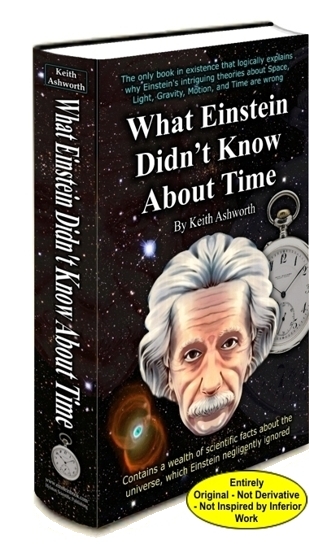 demonstrably false . demonstrably false .
Essentially, this unique 400 page hardback book, which contains over 145,500 words plus 40 illustrations within 18 logically structured chapters, enables both the lay reader, who possesses little or no knowledge of physical science, and the qualified physicist to re-evaluate the intellectual contribution that Einstein is reputed to have made to the ongoing debate about how the universe works.
Not only does the author detail Einstein’s life and times, but he also takes the reader inside the eccentric mind of Einstein in order to explain how and why he derived his intriguing theories about relative motion, the relativity of time and dimension, the allegedly invariant speed of light within a four-dimensional gravitationally warped hyperspace, and what prompted Einstein to contrive the famous equation E=mc².
Because the pioneering discoveries that were made by the likes
of Galileo, Newton, Faraday, and many other equally brilliant scientists are
detailed in the relevant chapters along with the theories that were subsequently
proposed to explain them, the reader soon becomes adequately qualified to
dispassionately reflect on several seemingly inexplicable experimental results that
Einstein inventively attempted to rationalise. He/she is then able to
objectively appraise the legitimacy of the author’s reservations about the logic that Einstein employed in his unconventional train of thought.
Clearly, the author has great faith in the ability of the reader to exercise common sense when passing judgement on the allegedly dazzling intellectual achievements that are repeatedly attributed to Einstein. Hence, although he draws attention to many profound flaws in Einstein’s theories, he does not tell the reader what conclusion he should arrive at, nor does he propose any baseless alternative theories that are intended to rival those proposed by Einstein. Instead, he rationalises the concepts of relative motion and dimension, analyses the phenomena of light, gravity and time, and presents innumerable unambiguous scientific facts that serve to demonstrate that the special and general theories of relativity are irredeemably flawed; thus the author elegantly undermines the myth that Einstein was the ultimate embodiment of genius.
In short, What Einstein Didn’t Know About Time is a uniquely entertaining book on the subject of popular science that details a mass of verifiable evidence that could change the course of history.
Discover Why Einstein's Reasoning Is Untenable
This remarkable book is an epic story that sensationally
exposes the numerous anomalies and conjectural flaws that reside within
Einstein’s version of relativity theory, all of which have been concealed beneath a superficial veneer of mathematical respectability. The dispassionate British author, Keith Ashworth, claims that Einstein’s contentions are erroneous primarily because his vivid imagination knew no bounds. Evidently, his unbridled creative bent enabled him to employ mathematics to justify the physical existence of a four-dimensional model of the universe that equates to a notional hypersphere comprised of space and time that is warped chaotically due to localised accumulations of mass. The geometric warps, which allegedly define the configuration of the gravitational field, are then supposed to determine the trajectories of material bodies and particles of light that travel through space. However, as the author explains, the theory of relativity, which asserts that the speed of light never varies due to the fact that the rate at which time elapses is dependent on the observer’s speed of motion, has been based entirely on abstract mathematical equations. Therefore, Einstein’s intriguing theory, like other tantalising mysteries, relies on the willingness of those who support it to accept many unproven facts.
Paradoxically, the reader does not need to know anything about the basic laws of physics in order to follow the logical progression of ideas that constitutes the narrative of What Einstein Didn’t Know About Time. So, there is no reason why an inquisitive individual should waste valuable time attempting to make sense out of what, more often than not, amounts to sensationalised science fiction when he/she can leisurely read about more plausible versions of reality that are based on proven unambiguous scientific facts. To make matters even simpler, many helpful illustrations are contained within the revelatory text; thus the prospective reader can rest assured that no prior knowledge with regards to the laws of motion or the nature of space and time is required in order to read and understand this fact packed informative book.
Therefore, on no account should What Einstein Didn’t Know About Time be regarded as just another invaluable guide to the fascinating subject of physical science. Instead, this unique book should be likened to intriguing food for thought because the contents are just as explosive as were those that were eloquently articulated almost four hundred years ago by Galileo in his controversial book that dared to challenge the authorised theory of planetary motion, which had been based on the hypothetical existence of a geocentric universe. The reason why the contents can justifiably be deemed to be controversial is because, in a balanced Galilean manner, the author presents an abundance of scientific evidence that he has been gleaned from the painstaking research of many qualified experimental physicists that undermines the extraordinary theories that were proposed by Einstein, and thus he is able to logically demonstrate that there are rational alternative explanations for each of the numerous anomalous experimental results that Einstein attempted to explain.
Never Mind the Quality, Just Check Out the Wi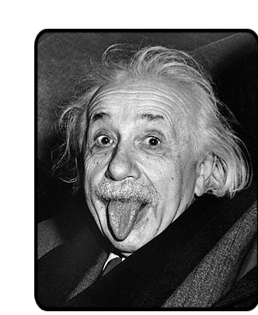 dth! dth!
Scientists have recently discovered that the core of Einstein’s brain was somewhat overdeveloped and that it lacked the central groove, which is usually present, and this had resulted in the cerebral cortex being 15% wider than that of the average human brain. They also allege that his general theory of relativity probably represents the most important development that has ever resulted from a modern-day mathematically defensible abstract train of thought. However, if the size and shape of the human brain is such a reliable guide to the intellectual prowess of its owner, then why is the author of 'What Einstein Didn’t Know About Time' able to provide an abundance of compelling evidence that validates arguments that are habitually advanced by many distinguished experimental physicists who reject the illogical paradoxes that are implicit in Einstein’s theories? The author certainly cites plenty of proven scientific facts that reinforce his assertion that many of Einstein’s adventurous assertions are invalid. Consequently, he cordially invites the reader to impartially consider the evidence and then judge for him/herself whether Einstein really did possess the brain of a gifted genius, or whether the recently discovered physical deformities had rendered his mind more aberrant than the millions of minds that reside within more cautious brains, the volumes of which are contained within dimensions that are deemed to be relatively normal.
|